How to read the Bible in a year
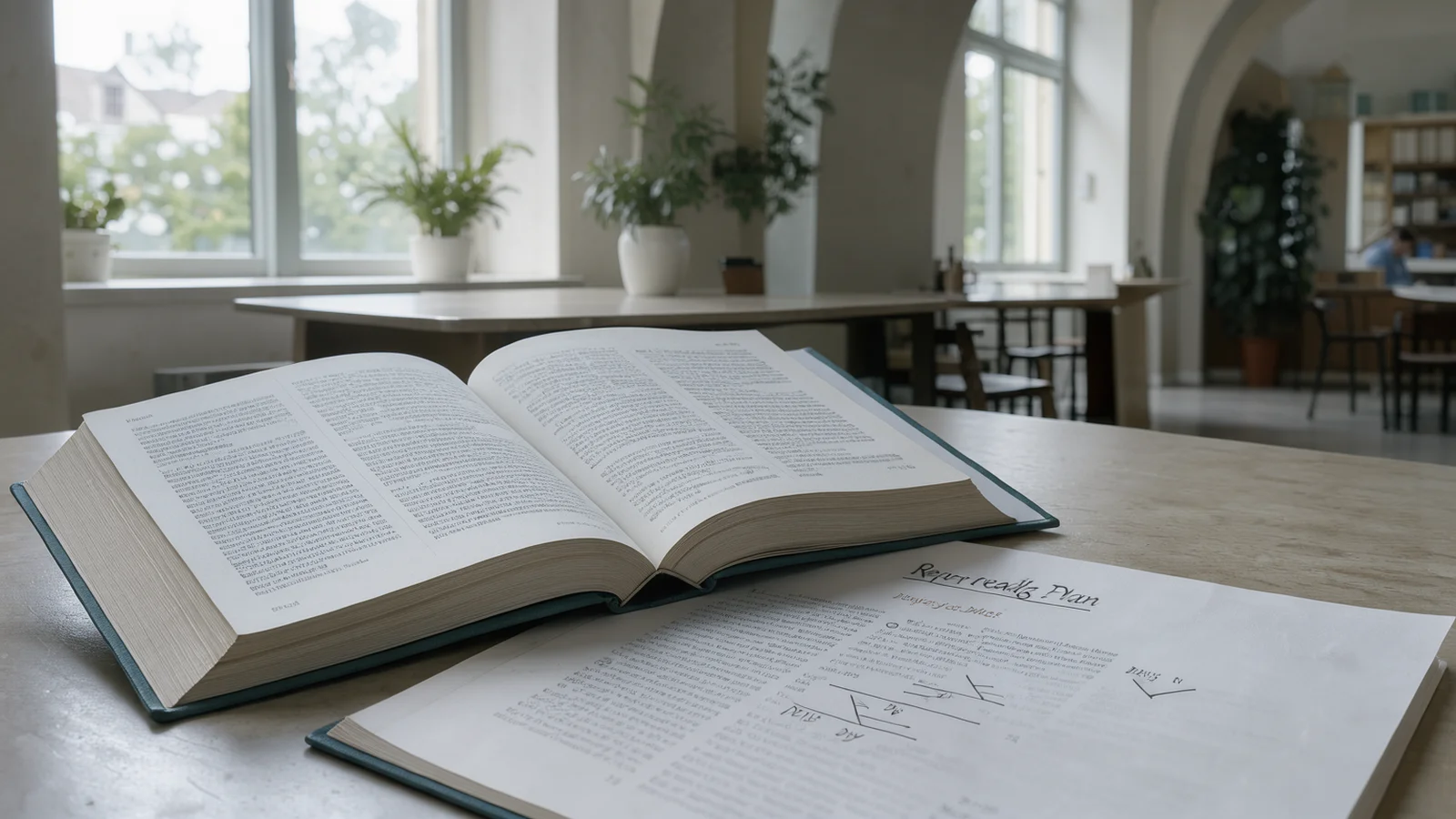
Reading the Bible in a year means about three chapters a day, every day, for twelve months. The Protestant Bible has 66 books and 1,189 chapters, 929 in the Old Testament and 260 in the New. Divided by 365, that comes to a little over three chapters a day. Chapters differ a lot in length. Psalm 117 has two verses, and Psalm 119 has 176, so some days take longer than others. The plan you choose shapes the experience more than the pace does. You can read the books in their printed order or follow a plan that rearranges them, and the sections below compare four such plans. Whatever the plan, a fixed time of day and a weekly catch-up day are what carry many readers to the end.
Why read the whole Bible
Many Christians know some parts of the Bible well and others hardly at all. A year of reading closes those gaps. You meet the minor prophets, the long history of the kings and the letters you skipped, and you start to see how they belong to one story.
Jesus treated the Scriptures as one story that pointed to him. After the resurrection, walking with two disciples, he started from the beginning.
And beginning with Moses and all the Prophets, He explained to them what was written in all the Scriptures about Himself.
Luke 24:27 BSB
Reading everything also protects you from building your faith on a few favorite verses. Paul told Timothy that the whole of Scripture is useful, the hard parts included.
All Scripture is God-breathed and is useful for instruction, for conviction, for correction, and for training in righteousness, so that the man of God may be complete, fully equipped for every good work.
2 Tim 3:16–17 BSB
Four ways to plan the year
Straight through in book order
The simplest plan reads the books in the order they appear. You always know where you are, and nothing gets skipped. The weak spot is the stretch from Leviticus to Deuteronomy, where laws, census lists and sacrifices fill page after page. Many readers stall there in February or March.
Old and New Testament every day
This plan splits each day's reading between the two Testaments. Some versions add a psalm as well. The New Testament has only 260 chapters, so in a one-year plan of this kind it gets less than one chapter a day, while the Old Testament gets two or three. The mix keeps the reading varied, so a dry chapter of laws sits next to a chapter of the Gospels. For a first year, this is often the easiest plan to finish.
In the order events happened
A chronological plan arranges the books in the order the events took place. Job is often read near Genesis, because many readers place him in the time of the patriarchs. The Psalms appear beside the parts of David's life they come from, and the prophets are read alongside the kings they spoke to. It takes some getting used to, but it makes the history much easier to follow, and it suits a second or third reading.
The M'Cheyne plan
Robert Murray M'Cheyne, a Scottish pastor, drew up a reading calendar for his congregation in 1842. It has four chapters a day from different parts of the Bible. In one year it takes you through the Old Testament once and through the New Testament and the Psalms twice. It's a heavier plan, and it works well for readers who already have the habit.
Catholic Bibles contain seven more books in the Old Testament, so Catholic year-long plans include them as well. The plans above are built on the 66 books.
How to keep going all year
Starting is easy, and January is full of fresh readers. Here is what helps them still be reading in June.
- Choose one time of day and stay with it. Early morning with coffee works for many people, and so does the half hour before bed. A reading tied to something you already do every day is much harder to forget.
- Print the plan or keep it in the front of your Bible, and tick off each day. A row of ticks is surprisingly good at keeping you going.
- Leave a catch-up day each week. Many one-year plans build one in. If yours doesn't, read four chapters a day for six days and keep the seventh free.
- When you miss days, return to today's reading. Trying to read nine chapters in one evening wears you out, and that's often where a plan stops. The missed chapters can wait for a light day.
- Read with someone. Someone else reading the same plan, even one friend, gives you a reason to keep up and someone to ask about a hard passage.
- Listen on busy days. An audio Bible during the commute or a walk still counts, and it carries you through the long lists of names.
Getting through the hard books
Every reader meets a wall somewhere. For many it's the laws of Leviticus. For others it's the long genealogies at the start of 1 Chronicles. A few things help.
Read the opening of the book first and ask what it's for. Leviticus tells how a holy God could live among an unholy people, and the sacrifices point forward to Christ. The New Testament letter to the Hebrews explains many of them.
Don't stop at every name or measurement. You don't have to understand every detail of the tabernacle to see that God was making a way to be near his people. Note your questions in the margin and keep going. Many of them answer themselves later in the year.
When a passage still feels heavy, remember the people of Jerusalem after the exile. They stood for hours while Ezra read the Law to them.
So Ezra read it aloud from daybreak until noon as he faced the square before the Water Gate, in front of the men and women and those who could understand. And all the people listened attentively to the Book of the Law.
Neh 8:3 BSB
Reading every day is an old practice
Daily reading wasn't invented for modern plans. God told Israel's future kings to keep a copy of the Law with them and read it daily.
It is to remain with him, and he is to read from it all the days of his life, so that he may learn to fear the LORD his God by carefully observing all the words of this instruction and these statutes.
Deut 17:19 BSB
The believers in Berea did the same with the apostles' teaching. Luke praised them for checking what Paul said against the Scriptures every day.
Now the Bereans were more noble-minded than the Thessalonians, for they received the message with great eagerness and examined the Scriptures every day to see if these teachings were true.
Acts 17:11 BSB
But his delight is in the Law of the LORD, and on His law he meditates day and night. He is like a tree planted by streams of water, yielding its fruit in season, whose leaf does not wither, and who prospers in all he does.
Ps 1:2–3 BSB
The first psalm describes a person who keeps coming back to God's word day and night, and it compares that person to a tree by the water. Such a tree doesn't grow in a day, and it keeps its leaves when the weather turns dry. A year of daily chapters is one simple way to keep coming back.
Start with today
You don't need to wait for January. Any date can be day one, and a year from now you'll have read every book of the Bible. Choose your plan, mark your first three chapters and read them today. If a year feels like too much, start with the New Testament alone. At one chapter a day it takes 260 days, and it's a good first step toward the whole Bible.